Calm in the Chaos
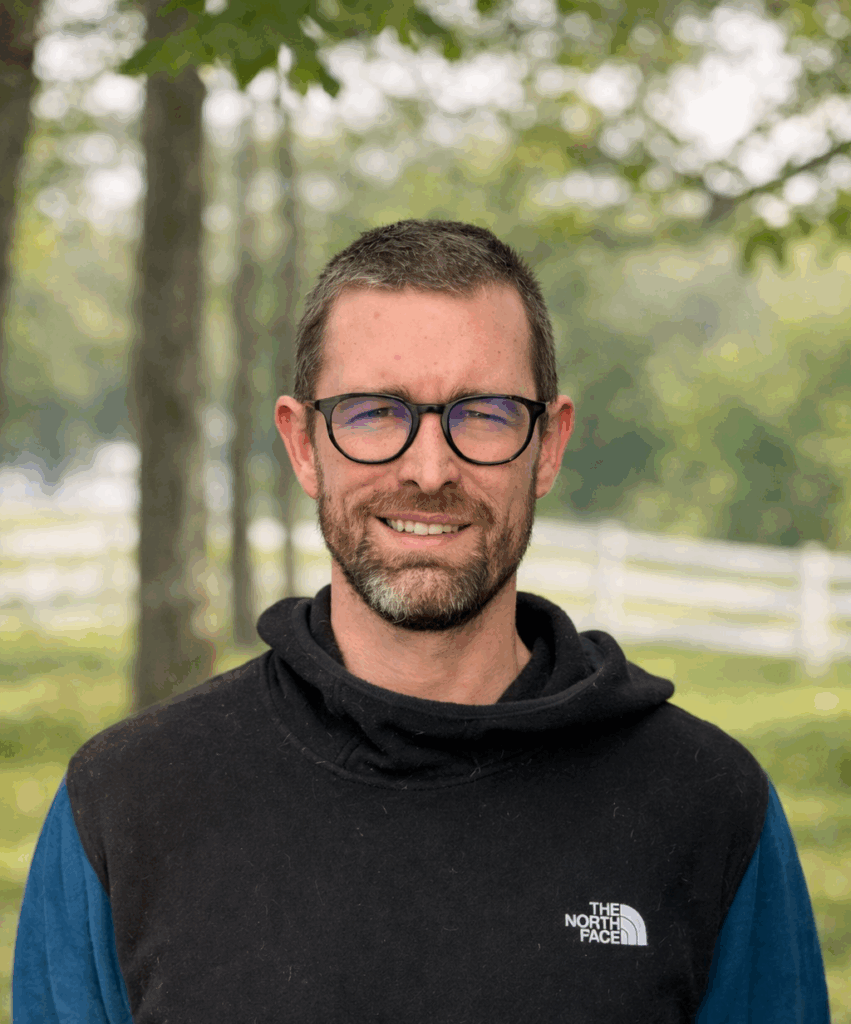
Clinician Matt Pedersen, MA, LCMHC, tends not to be phased by tough situations. After an unstable childhood, he found himself drawn to the challenge of working in high-needs settings. His desire to understand human motivation led him across the country, where he gained plenty of experience building rapport with complex students in major cities. Today Matt and his wife both work for Mountain Valley, and they’re enjoying a slower lifestyle while continuing to serve their community.
Tell us about your background?
“I was born in Poughkeepsie and I grew up in Hudson Valley between there and New York City. My grandparents are immigrants from Scandinavia, and I’m the first in my family to go to college. I had a complex family system growing up. My parents separated when I was young and they both had lots of different partners. At one point in high school, the district attorney raided our home, and my stepfather went to prison for white collar crime. I experienced a lot of different types of cultures and social classes growing up, from living in poverty to having some privilege and kind of back and forth. My whole life there have been these themes of intense complex stuff. It all resulted in me being deeply curious about why we are like this.
In college, I ended up studying human development because I didn’t know what I wanted to do and I just wanted to learn about all the different things. Before I picked human development, I like kind of went on a quest to just trying to study random interesting things, so I have a credit short of a minor in Africana Studies, and I have a good background of psychology. I did undergraduate in human development at Binghamton University New York State in 2009. That’s when of one of the economy collapses happened and a human developer isn’t really a job.
One of my friends from college had parents following the Grateful Dead around the world and worked in the music festival world. I fell in with them doing concert vending and things like that. Then I started thinking about why I work with people again. I thought about teaching or psychology but settled on counseling because I wanted to work directly with people rather than testing or something. I chose school over clinical first because I wanted to get exposure to as many types of humans as possible, and I figured I’d get more of that in the public schools.
I went for school counseling but did my clinical credits at the same time at Concordia in Chicago. Before moving to Chicago, I worked as a substitute teacher in New York State, then I worked at some charter schools in Chicago. I noticed that I liked working in high needs schools. But after grad school there weren’t many open positions in Chicago, so I cast a wide net and ended up in Denver. I had a choice of a few different schools, and I picked the middle school that was about to close because it had a reputation for being dangerous. It went from about 1,000 kids to 150 and was spinning its wheels. When I got there, they had the right combination of people. We had a six-year plan to try and turn the school around and we were able to accomplish that goal in several months. I started to get my feet wet with ERP and systematic desensitization and severe school avoidance, things like that. I got a reputation for being able to get the chronic school avoiders to come back to school.
I met my wife in Denver and when COVID hit, we thought about moving back to the East Coast to be closer to friends and family. We bounced around a few more times to New York, Las Vegas, Rhode Island, and the Mad River Valley. Eventually we moved to Philadelphia and my wife and I both worked at Strawberry High School in the Strawberry Mansion neighborhood. It has a bad reputation for dangerous gang crime and in the 90s it was declared the most dangerous high school in the country. My students experienced constant violence, gun violence, extreme trauma, all kinds of stuff happening. I was able to do some good work there, but it wasn’t worth the tradeoffs.”
How did you end up at Mountain Valley?
“My wife is from Claremont and Cornish, and her father owns some land, so we decided to roll the dice and move there. I considered working at area schools but decided on a mobile crisis position. I jumped into the clinical world pretty easily and got licensed. After that, I started looking around to see what else was out there, and we came across Mountain Valley. I was suspicious about how interesting it looked. I reached out to Alison and asked some tough questions, and she met everything with transparency and openness. It seemed like a really good place.
It’s a quite different population from others I’ve worked with but there is some consistent overlap. There’s a different kind of high need you get with resource and a different kind of complexity. In some ways it’s flashier to feel empathy for someone who doesn’t have any resources, but in some ways the privileged also suffer because they have the expectation that they should be fine. It is interesting, it keeps you on your toes to explain to lots of different people what you’re doing.”
What draws you to working in challenging situations?
“I think at the very beginning, even at a young age I remember being deeply curious, starting around three years old. I thought that there had to be more to how people interact. I thought if I tried to interact with people who have really complex things going on, maybe that would teach me more about people in general. As I started that work and realized I had some skill in it, and some ability to relate, it validated the anxiety and trauma I’d felt. It was really satisfying to find this ability that I have in high pressure situations to survive. I was able to find a meaningful place to channel my hypervigilance and awareness.
I enjoy the mystery or puzzle of trying to figure out what’s going on with a person. I also care quite a bit about social justice and felt it was important to try and give some resources to under-resourced populations. It’s a full circle moment to be able to help people with things that I couldn’t help myself with when I was young”
How do you connect with someone who’s particularly shut down? Any success stories you want to share?
“I try to meet someone where they are and respect their history before trying to address the present. I’ve gained a lot of skills in ERP, DBT, CBT, but the one I identify with most is a straight Rogerian perspective. I try to be the calmest person in the room and be authentic, generally that works. I go really hard on relationships and I like Viktor Frankl’s existential theory defining meaning. If you can find meaning and get your actions to line up with your values, you’ll have an easier time figuring out what you want. What do you really care about, and why do you care?
I have a couple residents who come to mind, actually my first two clients at Mountain Valley. One wasn’t really leaving the house much and was very dependent on their parents. They had a lot of learned behaviors that were kind of arrested development. We were able to identify that they were on the autism spectrum, which was missed for years and years. We helped get their function up and they agreed to attend boarding school, now they’re doing really well.
My other resident had really bad OCD, to the point where she couldn’t think or do school work. We identified PTSD from the family system and OCD that was learned from the family. The family did some work, and she found out that she could function. It’s especially satisfying when I can help clients not only feel better, but also contribute big things that they were unable to do before.”
Your wife recently joined you at Mountain Valley. What is that like and what are your future goals?
“My wife and I have a good working relationship—I’m feeling pretty well adjusted and she’s newer in her journey. Mountain Valley is a really nice place to work, it’s healthy and balanced for the most part. It’s fascinating to see what kind of work you can get done with a serious number of resources, which were kind of theoretical at other places I worked.
We’re excited about helping Mountain Valley become more trauma-informed. Looking to the future growth of Mountain Valley, we want to use the skills we’ve gained in other settings to help give more diverse folks access to residential care, especially those with less privilege.”
You’ve lived in many different places. What do you think of the Upper Valley?
“The pros of the Upper Valley are of course, beautiful nature and access to hiking, biking, all the things. In some ways it’s nice to be in the middle of nowhere and you get nature to yourself. It’s peaceful and quiet. I feel like I’m healing from working in some violent city settings. We’re kind of permanently camping in an RV, and it makes me feel more connected to the land.
The biggest drawbacks are lack of diversity and some close-mindedness that you encounter. But overall, it’s good because it allows you to really think about what’s important to you and it pushes you on personal growth and development.”